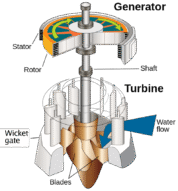
A Kaplan turbine is a highly efficient axial flow reaction turbine designed for low-head, high-flow hydroelectric power generation. Invented in 1913 by Austrian engineer Viktor Kaplan, this turbine revolutionized hydropower by integrating adjustable propeller blades with automated wicket gates, allowing it to maintain optimal performance across varying water flow rates and heads.
Often referred to as a propeller turbine, the Kaplan turbine is an advanced evolution of the Francis turbine, specifically engineered to operate efficiently in head ranges from 10 to 70 meters, making it ideal for run-of-river hydroelectric projects and river-based power stations.
⚙️ Working Principle of Kaplan Turbine
The Kaplan turbine operates on the reaction principle, where both pressure energy and kinetic energy of water are converted into mechanical energy. As water flows through the twisted adjustable blades of the runner, it generates a lift force opposite to the direction of flow. This force causes the runner to rotate, which in turn drives the generator shaft, producing electrical energy.
Key aspects of its working:
- Axial flow ensures smooth water movement along the turbine axis.
- Adjustable blades adapt to changing flow conditions, maximizing efficiency.
- Reaction force is generated due to pressure drop across the runner blades.
🧩 Main Components of Kaplan Turbine
| Component | Description |
|---|---|
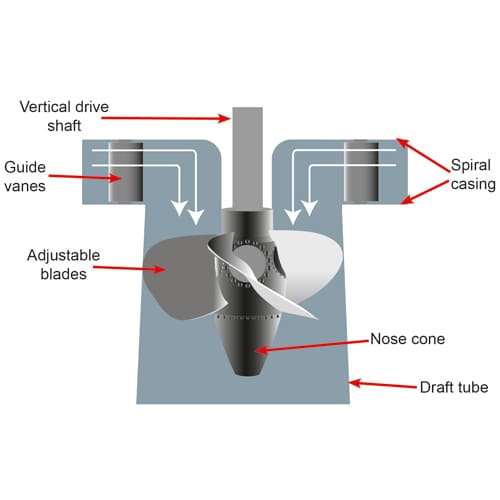
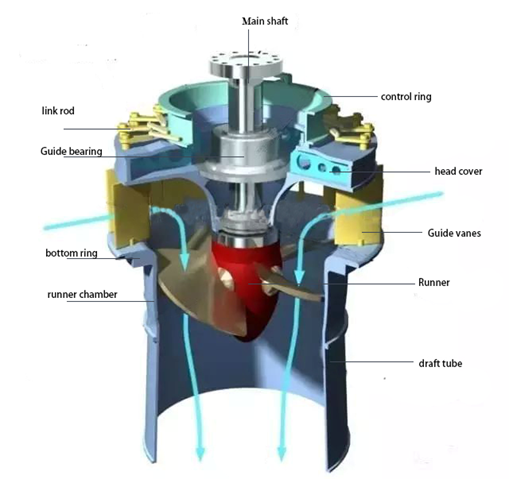
| Scroll Casing | Spiral-shaped casing that directs water from the penstock to guide vanes. Protects internal parts from external damage. |
| Guide Vanes | Adjustable vanes that regulate water flow and direct it onto the runner blades. Crucial for load-based efficiency control. |
| Runner & Blades | The rotating core of the turbine. Blades are twisted and adjustable to maintain optimal angle of attack. |
| Draft Tube | Diverging tube at the turbine exit. Converts kinetic energy into pressure energy and prevents backflow. |
🔄 Why Are Kaplan Turbine Blades Twisted?
The twisted blade design ensures that each section of the blade maintains an optimal angle of attack, allowing the turbine to operate efficiently across a wide range of flow rates and heads. This design minimizes energy loss and enhances overall performance.
🔁 Step-by-Step Working of Kaplan Turbine
- Water enters the scroll casing from the penstock.
- Guide vanes adjust automatically to direct water onto the runner blades.
- Reaction force from water flow causes the runner to rotate.
- Mechanical energy is transferred via the shaft to the generator.
- Water exits through the draft tube, where kinetic energy is recovered as pressure energy before discharge.
✅ Advantages of Kaplan Turbine
- 🌟 High efficiency under low-head and high-flow conditions.
- 🧱 Compact design requiring less installation space.
- 🔧 Easy maintenance and construction.
- ⚡ Superior performance compared to Francis turbines in similar environments.
- 🔄 Adjustable blades allow dynamic adaptation to flow variations.
⚠️ Disadvantages of Kaplan Turbine
- 💥 Cavitation risk, leading to blade erosion.
- 🛠️ Requires special materials like stainless steel to combat cavitation.
- ⚙️ Complex mechanism due to blade and vane adjustability.
- 💰 Higher initial cost due to sophisticated design and manufacturing.
🌍 Applications of Kaplan Turbine
- 🏞️ Hydropower plants with low-head (10–70 m) and high-flow water sources.
- 🌊 Run-of-river hydroelectric projects.
- 🏭 Medium to large-scale electricity generation.
- 🌐 Ideal for rivers, canals, and tidal power stations.